Yellow oriole
Icterus nigrogularis
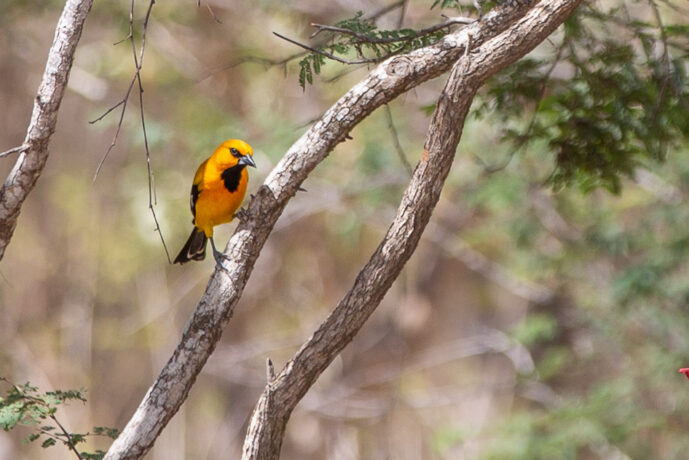
Quick Facts
- Scientific Name: Icterus nigrogularis
- Family: Icteridae
- Known Nicknames: Plantain oriole, Gonzalito
- Average Length: 20–21 cm / 8 in
- Average Weight: 38–41 g / 1.3–1.4 oz
- Wingspan: 28–32 cm / 11–12.5 in
- Key Feature: Vibrant yellow plumage with a contrasting black throat patch, black wings with white wing bars, and a black tail
- Primary Diet: Omnivore (Insects, fruit, and nectar)
- Range: Northern South America (Colombia, Venezuela, the Guianas), Trinidad, and the Dutch Caribbean (ABC islands)
- Habitat: Open woodlands, dry scrub, gardens, and mangrove edges
- Social Structure: Solitary or in pairs
- Nesting/Breeding: Long, pendulous bag-like nest suspended from the end of a tree branch
- Conservation Status: Least Concern (LC)
- Population Trend: Stable
The Yellow oriole (*Icterus nigrogularis*) is a brilliantly vibrant songbird native to northern South America and the Caribbean, instantly recognizable by its radiant, sunshine-yellow plumage. This striking color is contrasted sharply by a jet-black "bib" on its throat—a feature reflected in its scientific name—as well as dark wings and a black tail, both accented with crisp white feather edges. Beyond its vivid appearance, the species is renowned for its architectural ingenuity, weaving remarkable pendulous nests that can hang over six feet long from tree branches to protect its young from predators. A master of melody, the Yellow oriole fills its tropical habitat with a rich, flute-like whistling song, making it a captivating presence in both appearance and sound.
Habitats & Distribution
The geographical range of this species extends across northern South America, including Colombia, Venezuela, the Guianas, and northern Brazil. It is also native to several Caribbean islands such as Trinidad, Aruba, Curaçao, and Bonaire. Throughout these regions, it is typically a permanent resident, maintaining its presence in its established territories year-round.
In terms of habitat, it prefers open or semi-open environments over dense, continuous forest. It is frequently found in light woodlands, savannas with scattered trees, scrublands, and coastal mangroves. This bird has also adapted significantly to human-influenced landscapes, commonly inhabiting gardens, parks, and cultivated areas, especially those situated near water.
Behaviours & Reproduction
These birds are typically observed in monogamous pairs or small family units, maintaining strong social bonds through synchronized, flute-like vocalizations. They are highly territorial during the breeding season, vigorously defending their foraging areas and nest sites from intruders. Their daily activity involves foraging for insects, nectar, and fruit within open woodlands and cultivated gardens, often moving with agile, acrobatic grace through the canopy to locate food sources.
Reproduction is characterized by the construction of an elaborate, elongated pendant nest that can reach up to 40 centimeters in length. Meticulously woven from dry grasses and flexible plant fibers, these sack-like structures are suspended from the thin tips of high branches to provide protection against climbing predators like snakes. The female typically lays a clutch of two to three pale, blotched eggs, and while she handles the primary incubation, both parents participate in defending the site and provisioning the chicks with a high-protein diet of insects.
Diet
The yellow oriole maintains an omnivorous diet that primarily consists of insects, fruits, and nectar, showcasing a versatile foraging strategy across its tropical habitat. It actively hunts for various invertebrates, such as caterpillars, grasshoppers, and beetles, which it gleans from foliage or captures in mid-air. Beyond its protein intake, this bird consumes a wide array of berries and cultivated fruits, often using its sharp, pointed bill to pierce the skin and reach the succulent pulp. An interesting aspect of its feeding behavior is its role as a nectar consumer; the yellow oriole frequently visits flowering trees to drink nectar, inadvertently serving as a pollinator as it moves between blossoms. Furthermore, it is known for its opportunistic nature, readily visiting garden bird feeders for sugar water or fruit slices, which demonstrates its high level of adaptability to human-altered landscapes.
Colors
The yellow oriole is characterized by brilliant lemon-yellow plumage across its head and body, contrasted by a sharp black throat patch, lores, and bib. Its wings and tail are predominantly black, with the wings featuring distinct white feather edgings that form visible wing bars. Both sexes share this vivid coloration, which, despite its brightness, provides effective camouflage against the sun-dappled foliage of its tropical habitat.
Fun Facts
Yellow orioles are master architects, weaving pendulous, bag-like nests that can dangle up to 40 centimeters long from the tips of slender branches to outsmart climbing predators. Unlike many songbirds where only the male performs, these birds frequently engage in complex vocal duets where the pair sings in perfect synchrony to defend their territory. They also possess a specialized brush-tipped tongue, a unique adaptation that allows them to efficiently lap up nectar from tropical flowers, making them vital pollinators within their ecosystem.