Black-capped donacobius
Donacobius atricapilla
Quick Facts
- Scientific Name: Donacobius atricapilla
- Family: Donacobiidae
- Known Nicknames: Donacobius, Black-capped Mockingthrush
- Average Length: 21.5–23 cm / 8.5–9 in
- Average Weight: 30–42 g / 1.1–1.5 oz
- Wingspan: 25–30 cm / 9.8–11.8 in
- Key Feature: Bright orange-yellow iris, black crown, and rhythmic tail-fanning behavior
- Primary Diet: Insectivore
- Range: South America (East of the Andes) and Panama
- Habitat: Tropical freshwater marshes, swamps, and lakeside vegetation
- Social Structure: Highly social; cooperative breeders in pairs or family groups
- Nesting/Breeding: Open cup nest in reeds or aquatic vegetation over water
- Conservation Status: Least Concern (LC)
- Population Trend: Stable
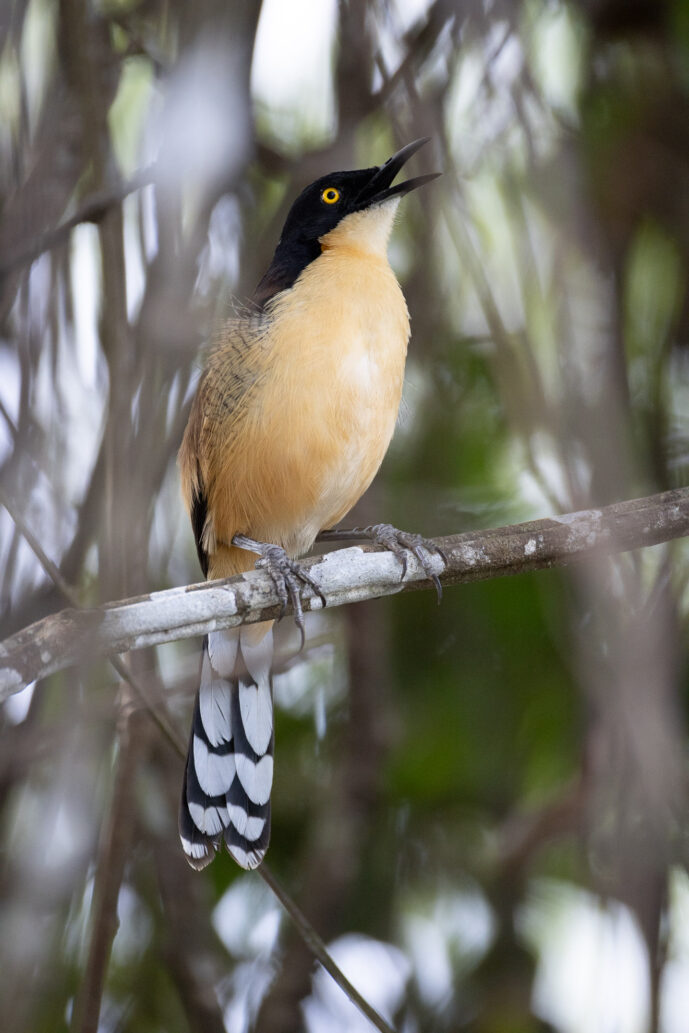
The Black-capped donacobius (*Donacobius atricapilla*) is a charismatic, social songbird of the tropical wetlands of South America and Panama, notable for being the sole member of its own unique taxonomic family, Donacobiidae. Striking in appearance, it features a velvet-black cap, a chocolate-brown back, and warm, buff-yellow underparts, all punctuated by a piercing, bright yellow eye. This bird is most famous for its highly synchronized "duetting" behavior; pairs often perch prominently on reeds to perform elaborate, rhythmic displays where they bob their bodies and fan their white-tipped tails in unison while emitting loud, liquid whistles. Once mistakenly classified as a wren or a thrasher, this "marsh-wren" stands out not only for its distinct evolutionary lineage but also for its spirited personality and unmistakable presence in the riverside vegetation.
Behaviours & Reproduction
These birds are highly territorial and social, often living in family groups that practice cooperative breeding. Monogamous pairs defend their wetland territories through conspicuous, synchronized displays; they perform loud vocal duets while perched together, often bobbing their bodies and fanning their long, white-tipped tails. A unique aspect of their social structure is the presence of "helpers"—typically offspring from previous years—who remain with the parents to assist in defending the territory and feeding the new nestlings. This collaborative effort significantly improves the survival rate of the brood and strengthens the group's hold on their habitat. Reproduction involves constructing an open cup-shaped nest made of grasses and aquatic vegetation, usually situated over water to provide protection from terrestrial predators. The female typically lays two eggs, which are incubated by both parents. Once the chicks hatch, the entire family group, including the helpers, participates in foraging and delivering food to the young. This extended family involvement is a defining reproductive strategy, as the juveniles stay within the parental territory for up to a year or more, learning complex social behaviors and vocalizations before eventually dispersing to establish their own territories.
Colors
The Black-capped donacobius is characterized by a sleek black cap and face that contrast sharply with its vivid yellow or orange eyes. Its back and wings are dark chocolate brown, while the underparts are a creamy buff that becomes barred with thin dark lines along the flanks. Notable features include large white tips on its long, dark tail and inflatable yellow skin patches on the sides of the neck used during vocal displays.