Blue-bellied Parrot
Open Bird Bucket List ↗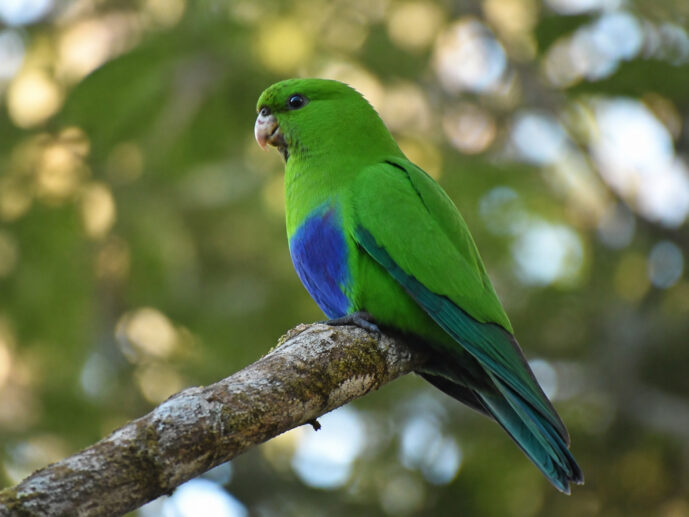
Quick Facts
- Scientific Name: Triclaria malachitacea
- Spanish Name: Tricahue
- Family: Psittacidae
- Known Nicknames: Blue-bellied Parrot, Malachite Parrot
- Average Length: 28–30 cm / 11–12 in
- Average Weight: 140–160 g / 4.9–5.6 oz
- Wingspan: N/A
- Key Feature: Bright blue belly patch contrasting with green body
- Primary Diet: Primarily Frugivore
- Range: Southeastern Brazil
- Habitat: Humid Atlantic Forest, lowland and montane rainforests
- Social Structure: Pair-living or small flocks
- Nesting/Breeding: Tree hollows
- Conservation Status: Near Threatened (NT)
- Population Trend: Decreasing
The Blue-bellied Parrot (*Triclaria malachitacea*), a strikingly monomorphic species endemic to the Atlantic Forest of southeastern Brazil, is a medium-sized parrot distinguished by its most remarkable feature: the male’s vivid, turquoise-blue belly patch that starkly contrasts with its otherwise entirely grass-green plumage, while the female lacks this blue and remains uniformly green. Its long, graduated tail and pale, horn-colored beak give it an elegant, streamlined silhouette, and it is known for its quiet, whistling calls that echo through the humid canopy. A special ecological trait is its strong reliance on the fruit of the native palm *Euterpe edulis* (juçara), making it a key seed disperser, though habitat loss and trapping for the pet trade have rendered it a Near Threatened species.
Fun Facts
Despite its name, the Blue-bellied Parrot’s most striking feature is actually a hidden secret: only the male sports the vivid blue belly patch, which he flaunts during courtship, while the female is entirely green. This species is a master of camouflage in its Brazilian Atlantic Forest home, often freezing mid-bite on a fruit to avoid detection. It has a quirky habit of hanging upside down like a bat to reach hard-to-access fruits, and it produces a surprisingly soft, cat-like mewing call rather than the harsh squawks typical of parrots. Uniquely, it is one of the few parrot species that shows a strong preference for a single tree species (the *Euterpe edulis* palm) for nesting, making it highly dependent on the health of these palms.
Habitats & Distribution
The Blue-bellied Parrot is endemic to the Atlantic Forest of southeastern Brazil, with its distribution ranging from southern Bahia and Espírito Santo south through Rio de Janeiro, São Paulo, and into northeastern Santa Catarina. Its habitat consists primarily of humid, lowland and montane primary forests, often near water sources such as rivers and streams. It is also found in adjacent forest fragments and tall secondary growth, but it avoids heavily deforested or open areas, relying on continuous canopy cover for foraging and nesting in tree cavities.
Behaviours & Reproduction
Mating pairs form strong, long-term bonds, often remaining together year-round within small, loose flocks that may include their offspring from previous seasons. Males perform courtship displays involving head-bobbing, wing-lifting, and soft chattering while offering food to the female. Nesting occurs in natural tree cavities, where the female lays 2–4 white eggs and incubates them alone for about 26 days, during which the male regularly feeds her. Both parents share feeding duties for the altricial chicks, which fledge around 7–8 weeks. A unique strategy is their reliance on specific large-bore hollows in mature Atlantic Forest trees, making them highly sensitive to habitat fragmentation.
Diet
The Blue-bellied Parrot (Triclaria malachitacea) is primarily frugivorous, with a diet heavily centered on the fruits of native Atlantic Forest trees, such as those from the Myrtaceae family (including guavas and pitangas). It is also known to consume seeds, flowers, and nectar, occasionally foraging in small flocks. A particularly interesting aspect of its diet is its strong reliance on the fruits of the palm tree *Euterpe edulis* (the juçara palm), making the species a key seed disperser for this threatened plant. Additionally, these parrots have been observed licking clay from riverbanks, likely to obtain minerals and neutralize toxins found in unripe fruits.
Colors
The Blue-bellied Parrot is primarily green with a distinctive bright blue patch on its lower belly and vent. Males have a blue lower mandible, while females have a blackish one. The tail is long and graduated, with reddish tips visible in flight. Its green upperparts provide excellent camouflage in the forest canopy, with no disruptive patterns or additional markings.
Distribution Map
Places linked to this species. A sighting is never guaranteed.
Use the map filter to show only featured places.
Featured places
