Gilt-edged Tanager
Tangara cyanoventris
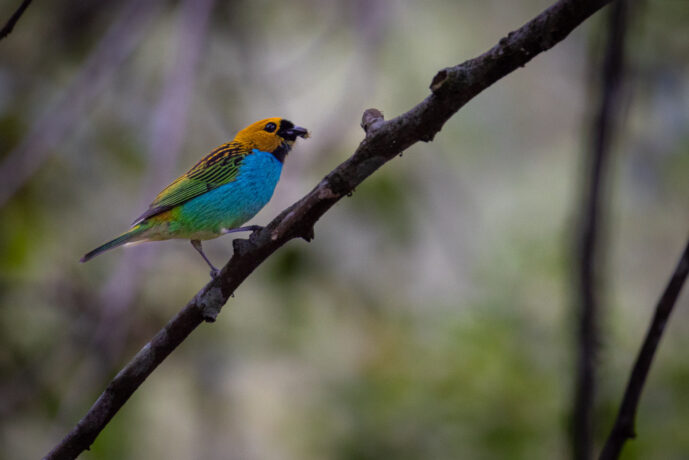
Quick Facts
- Scientific Name: Tangara cyanoventris
- Family: Thraupidae
- Known Nicknames: Saíra-dourada
- Average Length: 13.5 cm / 5.3 in
- Average Weight: 17.5–20.5 g / 0.62–0.72 oz
- Wingspan: 18.5–21 cm / 7.3–8.3 in
- Key Feature: Vibrant golden-yellow head and breast with a black face mask and scaly black-and-green scalloped plumage on the back
- Primary Diet: Omnivore (Primarily frugivorous and insectivorous)
- Range: Endemic to Southeastern Brazil (Minas Gerais, Espírito Santo, Rio de Janeiro, and São Paulo)
- Habitat: Humid montane forests, forest edges, and mature secondary growth
- Social Structure: Social; typically found in pairs or small groups and frequently joins mixed-species foraging flocks
- Nesting/Breeding: Cup-shaped nests constructed in trees or dense shrubs
- Conservation Status: Least Concern (LC)
- Population Trend: Stable
Habitats & Distribution
This species is endemic to the Atlantic Forest of southeastern Brazil, where its range extends through the states of Bahia, Minas Gerais, Espírito Santo, Rio de Janeiro, and São Paulo. It is found across both coastal and interior montane regions, maintaining a presence throughout the fragmented remains of its native biome. It primarily inhabits humid montane forests and forest borders, typically occurring at elevations between 500 and 1,200 meters. While it favors the canopy of primary forests, it is also frequently observed in mature secondary-growth forests and occasionally in suburban parks or gardens that provide sufficient native tree cover.
Behaviours & Reproduction
These social birds are typically observed in pairs or small family groups of three to six individuals, often joining larger mixed-species flocks to forage within the forest canopy. Their social structure is highly cohesive, as they move through the trees searching for fruits and insects while maintaining vocal contact. During the breeding season, they form monogamous pairs that establish territories, though they remain relatively tolerant of other group members. Nesting involves the construction of a compact, cup-shaped structure made from moss and fine plant fibers, meticulously concealed within dense foliage. A distinctive reproductive strategy sometimes observed is cooperative breeding, where additional group members assist the primary pair in feeding and defending the nestlings. While the female typically incubates the clutch of two eggs, both parents, and occasionally their helpers, are deeply involved in provisioning the young until they reach independence.
Diet
The Gilt-edged Tanager maintains an omnivorous diet primarily composed of a variety of small fruits, berries, and arthropods. Foraging actively within the canopy and mid-story of humid forests, this species frequently consumes fruits from the Melastomataceae family and small insects like caterpillars and spiders gleaned from the undersides of leaves or mossy branches. An interesting aspect of their feeding behavior is their remarkable agility; they are often observed hanging acrobatically upside down to reach elusive food items or probing into epiphytes for hidden prey. Furthermore, while they typically forage in mixed-species flocks to maximize efficiency, they have also shown a willingness to visit urban bird feeders, particularly favoring soft fruits like bananas and oranges.
Colors
The Gilt-edged Tanager features a vibrant golden-yellow head and neck contrasted by a stark black mask and throat. Its upperparts are yellowish-green with heavy black scalloping, while the breast and belly are a striking turquoise-blue. This combination of brilliant primary colors and dark dorsal streaking provides both high-visibility signaling and effective camouflage within the sun-dappled foliage of the Atlantic Forest canopy.
Fun Facts
The Gilt-edged Tanager is a social acrobat often found hanging completely upside down to snatch insects or small fruits from the underside of leaves and bromeliads. These birds are highly gregarious and almost always travel in mixed-species "party flocks," where their brilliant golden-yellow plumage surprisingly serves as effective disruptive camouflage within the sun-dappled canopy of the Brazilian Atlantic Forest. Beyond their foraging antics, they play a vital role in their ecosystem by specializing in eating mistletoe berries, acting as primary seed dispersers for these parasitic plants as they move through the treetops.