Hyacinth Macaw
Anodorhynchus hyacinthinus
Quick Facts
- Scientific Name: Anodorhynchus hyacinthinus
- Family: Psittacidae
- Known Nicknames: Hyacinthine Macaw, Blue Macaw, Gentle Giant
- Average Length: 100 cm / 39.4 in
- Average Weight: 1.2–1.7 kg / 2.6–3.7 lb
- Wingspan: 117–127 cm / 46–50 in
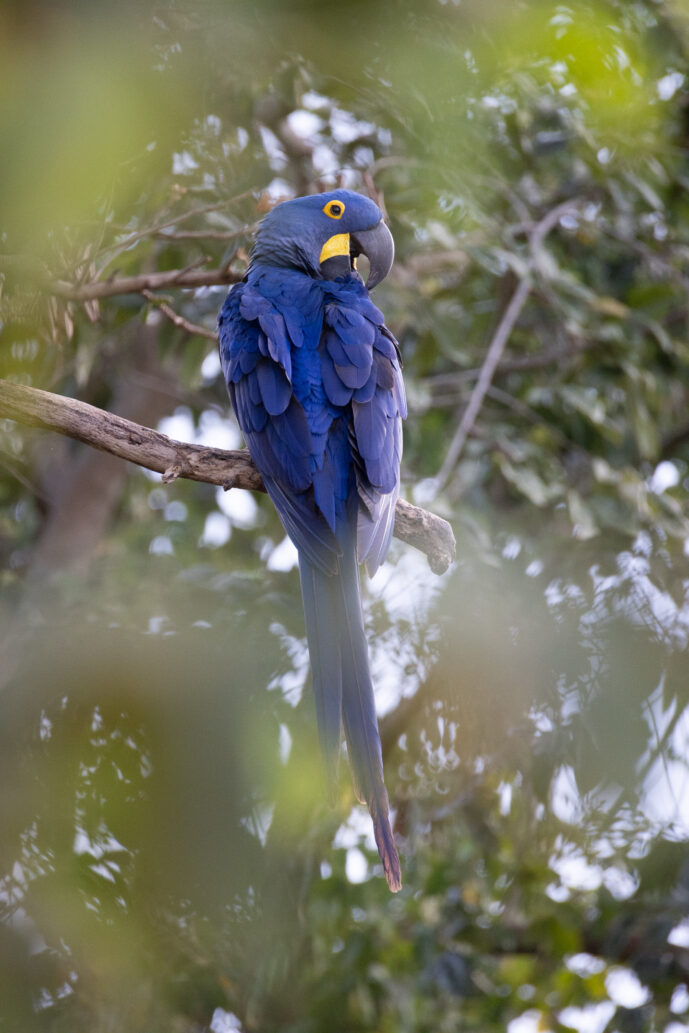
- Key Feature: Vibrant cobalt-blue plumage with bright yellow rings around the eyes and at the base of the lower mandible
- Primary Diet: Primarily Granivore (specializing in hard palm nuts)
- Range: Central and eastern South America, primarily within Brazil, eastern Bolivia, and northeastern Paraguay
- Habitat: Semi-open habitats, including Pantanal wetlands, Cerrado savannas, and palm groves
- Social Structure: Highly Social, typically seen in pairs, family groups, or small flocks
- Nesting/Breeding: Tree hollows (especially Manduvi trees) or cliff face crevices
- Conservation Status: Vulnerable (VU)
- Population Trend: Decreasing
The Hyacinth Macaw (*Anodorhynchus hyacinthinus*) is a breathtaking spectacle of the avian world, reigning as the largest flying parrot species with a length reaching up to 40 inches. Cloaked in a vibrant, uniform mantle of deep cobalt-blue feathers, this "gentle giant" is instantly recognizable by the striking patches of bright yellow skin encircling its dark eyes and the base of its massive, hooked black beak. This formidable beak is a marvel of nature, possessing enough strength to crack hard-shelled nuts that other animals cannot, including coconuts and macadamias. Native to the palm swamps and woodlands of South America, the Hyacinth Macaw is celebrated not only for its immense size and stunning coloration but also for its high intelligence and remarkably social, affectionate personality.
Habitats & Distribution
This species is native to central and eastern South America, with its distribution primarily concentrated in three distinct regions: the Pantanal of Brazil, eastern Bolivia, and northeastern Paraguay; the Cerrado region of eastern Brazil; and the Amazon Basin near the Tapajós River. Unlike many other large parrots, it tends to avoid dense, humid rainforests, preferring more open or semi-open landscapes that allow for easier navigation. In these regions, it inhabits palm swamps, seasonally flooded grasslands, and dry woodlands. It is particularly dependent on areas featuring stands of specific palm trees, which provide its primary food source, and large deciduous trees like the manduvi, which are essential for nesting. These specialized environments offer the necessary combination of open flight paths and concentrated food resources required for its survival.
Behaviours & Reproduction
Highly social and intelligent, these birds form strong, lifelong monogamous pair bonds and are typically seen in pairs or small family groups. They maintain these connections through mutual preening and frequent vocalizations, which serve to reinforce social hierarchies and pair stability. During the breeding season, which usually spans from July to December, they primarily nest in the hollows of Manduvi trees or on sandstone cliffs. Their reproductive strategy is characterized by a low birth rate and high parental investment, as pairs often produce only one or two eggs per season. While two eggs may be laid, often only one chick survives, as the older sibling frequently outcompetes the younger for food. The female handles the majority of the incubation for about 25 to 28 days, while the male provides food and guards the nest site. Once hatched, the young are slow to develop, fledging after approximately 110 days but remaining dependent on their parents for up to a year. This extended period of parental care is crucial for the offspring to learn the complex foraging techniques required to crack the exceptionally hard palm nuts that make up their specialized diet.
Diet
The Hyacinth Macaw possesses a highly specialized diet primarily consisting of the hard nuts from native palms, such as the acuri and bocaiuva. Their exceptionally powerful beaks are capable of exerting pressure exceeding 1,200 pounds per square inch, allowing them to crack open shells that are otherwise impenetrable to most other animals, including coconuts and macadamia nuts. Interestingly, these parrots often forage for palm nuts that have been partially digested and excreted by cattle; the bovine digestive process softens the tough outer husks, making the kernels significantly easier for the birds to access. Furthermore, they are known to engage in geophagy, the practice of consuming mineral-rich clay from riverbanks, which is believed to help neutralize dietary toxins and provide essential minerals that are lacking in their primary food sources.
Colors
The Hyacinth Macaw is defined by its vibrant, solid cobalt-blue plumage that covers the entire body. It features distinctive, bright yellow rings of bare skin around the eyes and a matching yellow patch at the base of the lower mandible. While it lacks intricate patterns, the deep blue coloration provides a form of disruptive shading against the forest canopy and sky, though the bird is primarily known for its bold, high-contrast visibility.
Fun Facts
Known as "gentle giants," these stunning birds possess a beak so powerful it can easily crack coconuts and has even been known to snap the metal bars of cages. Despite this strength, they demonstrate remarkable intelligence and have been observed using tools, such as wrapping a leaf around a slippery nut to keep it steady while they work on it. Their vibrant cobalt plumage is accented by bright yellow skin patches around their eyes and the base of their beak, creating a permanent "smiling" expression. Highly social and affectionate, they often engage in loud, playful acrobatics and use their zygodactyl feet like hands to manipulate objects with incredible precision.