Red-cowled Cardinal
Paroaria dominicana
Quick Facts
- Scientific Name: Paroaria dominicana
- Family: Thraupidae
- Known Nicknames: Dominican Cardinal, Pope Cardinal
- Average Length: 16.5–19 cm / 6.5–7.5 in
- Average Weight: 25–30 g / 0.88–1.06 oz
- Wingspan: 25–30 cm / 9.8–11.8 in
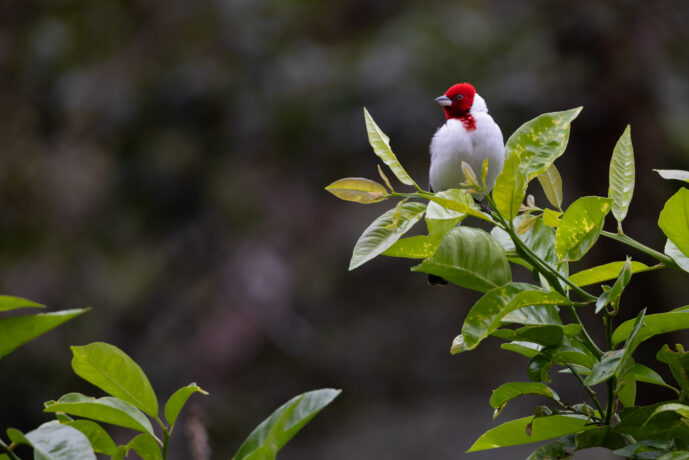
- Key Feature: Vibrant red head, throat, and upper breast without a crest, contrasting with white underparts and grey upperparts
- Primary Diet: Omnivore (Seeds, fruits, and insects)
- Range: Northeastern Brazil
- Habitat: Caatinga scrubland, dry forests, and shrubby gardens
- Social Structure: Pairs or small family groups
- Nesting/Breeding: Cup-shaped nests in dense shrubs or low trees
- Conservation Status: Least Concern (LC)
- Population Trend: Stable
The Red-cowled Cardinal (*Paroaria dominicana*) is a striking songbird endemic to the arid Caatinga brushlands of northeastern Brazil, instantly recognizable by its brilliant crimson head and throat. Unlike many other species in the cardinal family, this bird lacks a pointed crest, sporting instead a sleek, rounded "cowl" that contrasts vividly against its snowy-white underparts and charcoal-grey back. Beyond its bold aesthetic, the Red-cowled Cardinal is celebrated for its social nature and melodic, flute-like song, often seen foraging in pairs or small groups through scrubby vegetation. Its resilient ability to thrive in harsh, dry environments, combined with its piercing red gaze and elegant plumage, makes it one of the most iconic and charismatic avian residents of the Brazilian interior.
Habitats & Distribution
This species is endemic to northeastern Brazil, with a geographical range that spans from the states of Maranhão and Piauí south to northern Minas Gerais. It is a characteristic inhabitant of the Caatinga biome, a semi-arid region defined by xeric shrubland and thorny dry forests. Within this territory, the bird favors semi-open environments, including riverine thickets, scrubby pastures, and agricultural edges. It is highly adaptable and frequently occurs in human-modified landscapes such as suburban gardens and parks, particularly those located near water sources or in areas with dense undergrowth.
Behaviours & Reproduction
Highly social and often seen in pairs or small family groups, these birds transition from communal foraging to intense territoriality during the breeding season. Males utilize complex vocalizations and displays of their vibrant plumage to establish and defend nesting sites from rivals. This territorial behavior ensures that the pair has exclusive access to the insects and seeds necessary to sustain their young in the semi-arid environments they inhabit. Reproduction is typically monogamous and synchronized with the arrival of the rainy season to ensure an abundance of food. The pair works together to construct a cup-shaped nest from twigs and fibers, usually well-concealed in dense shrubs. Females lay a small clutch of two to three eggs, and while incubation is primarily the female's task, both parents are deeply involved in brooding and feeding the chicks. This biparental care is a critical strategy for increasing fledgling survival rates in often unpredictable climates.
Diet
The Red-cowled Cardinal is primarily an omnivorous bird with a strong preference for seeds and small fruits found throughout its native range in northeastern Brazil. Its diet consists largely of various grass seeds and seasonal berries, though it also opportunistically consumes insects and other small invertebrates to supplement its protein intake, especially during the breeding season. An interesting aspect of its feeding behavior is its tendency to forage on the ground, often in pairs or small groups, where it meticulously searches through leaf litter for fallen seeds. Furthermore, this species demonstrates significant dietary flexibility by frequently visiting human-populated areas to feed on bird tables, where it readily consumes cornmeal, cracked corn, and various cultivated fruits, showcasing an adaptability that allows it to thrive in both wild and urbanized environments.
Colors
The Red-cowled Cardinal is characterized by a vibrant crimson head and throat that forms a distinct "cowl" against a crisp white chest and belly. Its upperparts, including the back, wings, and tail, are a solid slate gray, creating a sharp tri-colored appearance. While the bold red serves primarily for social signaling, the neutral gray dorsal plumage provides some visual integration within the dry, scrubby environments of its native habitat.
Fun Facts
Despite its common name, this species is actually a member of the tanager family rather than a true cardinal. These birds are famous for their "dawn song," a complex series of melodic whistles performed early in the morning to establish territory before the heat of the day sets in. During social interactions, they perform rhythmic tail-flicking and wing-shivering displays to communicate with mates or rivals. Interestingly, juveniles lack the iconic crimson plumage of adults, instead sporting a dull brownish head that provides essential camouflage against the scrubby vegetation of their native Brazilian habitat until they reach maturity.