Red milkweed locust
Phymateus morbillosus
Quick Facts
- Scientific Name: Phymateus morbillosus
- Family: Pyrgomorphidae
- Known Nicknames: Red milkweed grasshopper, Common milkweed locust
- Average Length: 7–10 cm / 2.7–3.9 in
- Average Weight: 10–20 g / 0.35–0.7 oz
- Wingspan: 12–15 cm / 4.7–5.9 in
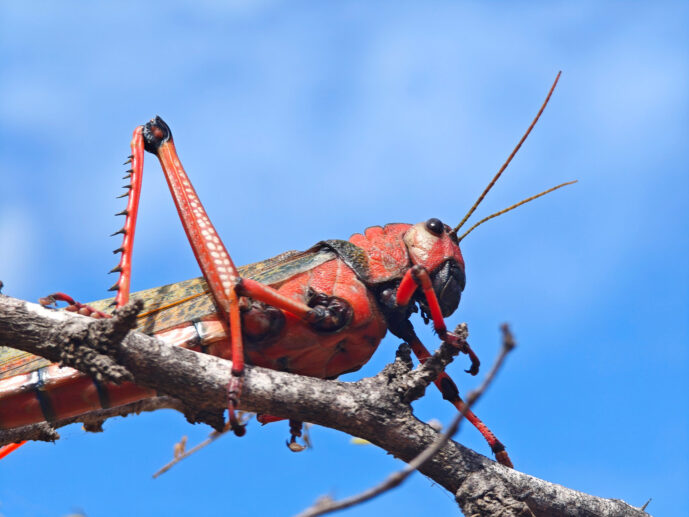
- Key Feature: Bright red and black aposematic coloration with a heavily textured, warty pronotum
- Primary Diet: Herbivore (Polyphagous, specializing in toxic plants like Asclepiadoideae)
- Range: Southern Africa, including South Africa, Namibia, Botswana, and Zimbabwe
- Habitat: Semi-arid scrublands, savannas, and Karoo biomes
- Social Structure: Highly gregarious as nymphs; adults are more solitary or found in loose aggregations
- Nesting/Breeding: Underground (egg pods deposited in the soil)
- Conservation Status: Not Evaluated (Commonly considered Least Concern)
- Population Trend: Stable
The Red milkweed locust (*Phymateus morbillosus*) is a visually stunning and formidable insect native to Southern Africa, renowned for its large size and vibrant, aposematic coloration. Reaching lengths of up to ten centimeters, this locust displays a brilliant mosaic of red, yellow, and green, which serves as a vivid warning to predators of its high toxicity. Its most striking physical characteristic is a heavily textured, warty thorax that gives it a rugged, prehistoric appearance. As a specialist feeder on toxic milkweed plants, it sequesters harmful cardiac glycosides within its body; when threatened, it can dramatically expel a foul-smelling, noxious foam from specialized thoracic glands. This combination of chemical weaponry and brilliant "stay away" signaling allows the Red milkweed locust to move sluggishly through its habitat with remarkable impunity.
Habitats & Distribution
This species is native to Southern Africa, where it is widely distributed across countries such as South Africa, Namibia, Botswana, and Zimbabwe. It thrives primarily in semi-arid regions and temperate zones that support the growth of its host plants, maintaining a consistent presence throughout both inland and coastal provinces within its geographical range. Its habitat consists mainly of open scrublands, savannas, and grasslands where milkweed and other toxic vegetation are abundant. These locusts are also frequently encountered in disturbed environments, including rural gardens and the outskirts of agricultural land, provided there is sufficient low-lying flora for feeding and breeding. They favor sunny, well-drained areas that facilitate their development and allow them to congregate near their primary food sources.
Behaviours & Reproduction
These insects exhibit a largely gregarious nature, particularly during their nymphal stages, where they form dense clusters on host plants to deter predators. They are notably slow-moving and rely on aposematic coloration—vibrant reds, yellows, and greens—to signal their toxicity. When threatened, they employ a unique defensive behavior by exuding a foul-smelling, toxic froth from thoracic glands, which is synthesized from the cardiac glycosides found in the milkweed they consume. Reproduction involves a process where males mount females for extended periods to ensure successful fertilization. Following mating, the female uses her abdomen to excavate a hole in the soil, where she deposits a foam-protected egg pod containing dozens of eggs. This underground incubation protects the offspring from desiccation and environmental threats until they emerge as flightless nymphs. Unlike many other migratory locust species, they do not undergo a dramatic swarming phase, remaining relatively localized throughout their life cycle.
Diet
The Red milkweed locust is a polyphagous herbivore with a specialized preference for toxic plants, particularly those within the milkweed (Apocynaceae) and nightshade (Solanaceae) families. A fascinating characteristic of its diet is the sequestration of cardiac glycosides from these host plants; by consuming these chemicals, the locust stores the toxins within its own body to become highly unpalatable and poisonous to potential predators. This chemical defense is advertised through its vibrant aposematic coloration, signaling to birds and other animals that it is a dangerous meal. While they are capable of feeding on a wide range of vegetation, including garden plants and certain crops, their physiological adaptation to process and utilize plant toxins is their most distinctive dietary trait. Furthermore, the nymphs often exhibit gregarious feeding behavior, clustering in large groups to systematically defoliate a single host plant before migrating to find new nourishment.
Colors
The red milkweed locust displays striking aposematic coloration, featuring a dark green or black body adorned with vivid red, orange, and yellow nodules across its bumpy thorax. While its leathery forewings are typically olive-green with pale speckles for subtle blending, it reveals brilliant crimson or pink hindwings when disturbed. These bold, contrasting patterns serve as a high-visibility warning to predators that the insect is toxic from sequestering alkaloids found in its milkweed diet.
Fun Facts
These insects are masters of chemical warfare, sequestering toxic cardiac glycosides from their diet to become lethal to most predators. When threatened, they discharge a noxious, foul-smelling foam from their thoracic joints, creating a bubbling deterrent that is as unpleasant as it is effective. They also perform dramatic deimatic displays, suddenly flashing vivid hindwings and emitting a raspy hiss to startle attackers. Because they are so heavily armed with toxins, they exhibit a peculiar lack of fear, often moving at a sluggish pace or refusing to hop away even when directly approached.