White-crowned Parrot
Open Bird Bucket List ↗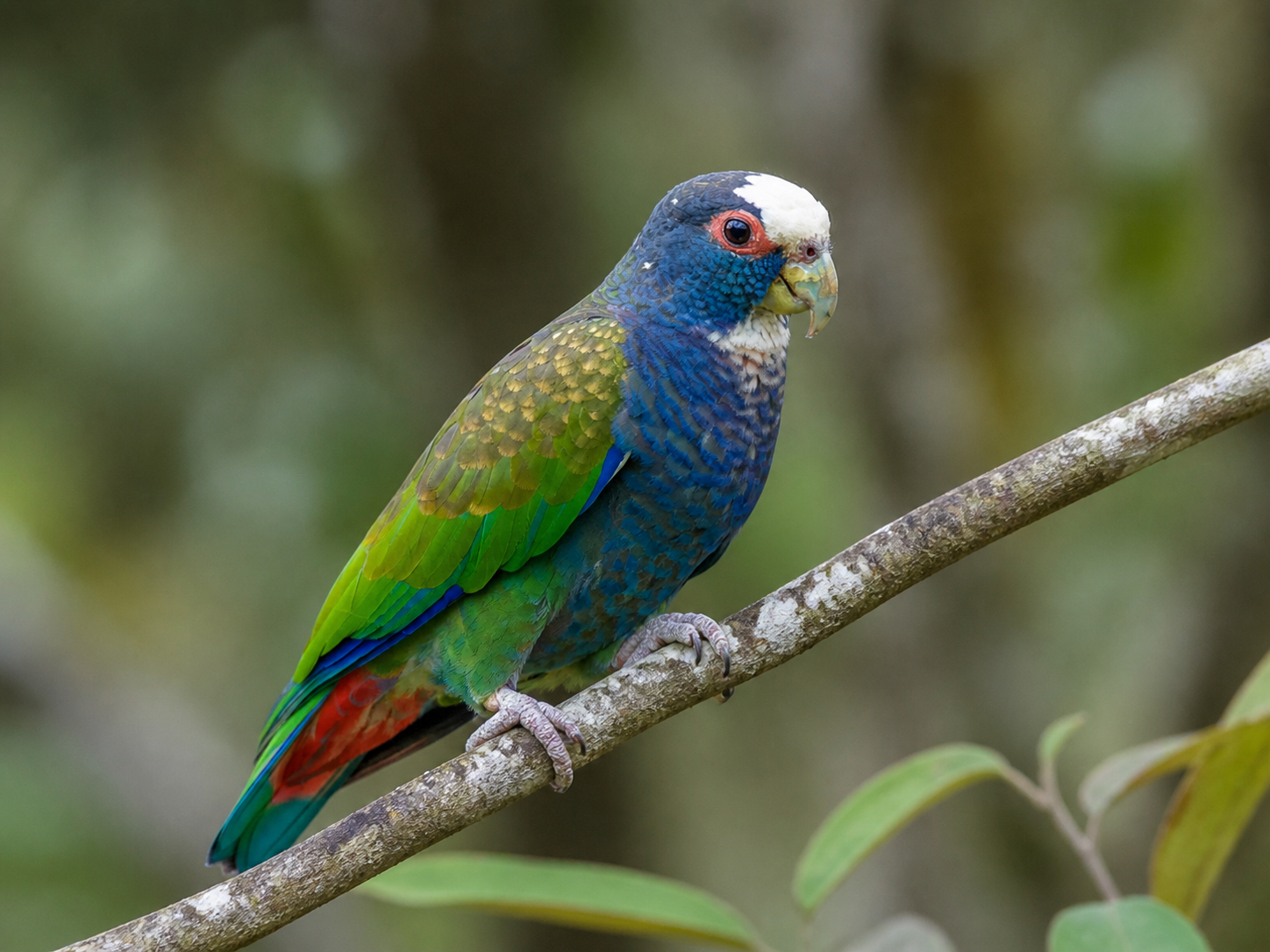
Quick Facts
- Scientific Name: Pionus senilis
- Spanish Name: Amazona frentiblanca
- Family: Psittacidae
- Known Nicknames: White-crowned Pionus, White-crowned Parrot
- Average Length: 24 cm / 9.5 in
- Average Weight: 193–235 g / 6.8–8.3 oz
- Wingspan: N/A
- Key Feature: White forehead and crown contrasting with blue throat and red vent
- Primary Diet: Primarily Frugivore
- Range: Central America from eastern Mexico to western Panama
- Habitat: Humid lowland and montane forests, forest edges, and semi-open areas
- Social Structure: Social, often seen in pairs or small flocks
- Nesting/Breeding: Tree cavities
- Conservation Status: Least Concern (LC)
- Population Trend: Stable
The White-crowned Parrot (*Pionus senilis*) is a captivating medium-sized parrot native to the humid forests of Central America, from Mexico to Panama. Its most striking feature is the crisp, white crown and forecrown that contrast sharply with its deep, glossy green body, while a subtle blueish wash on the throat and chest adds to its dignified appearance. Unlike many parrots, this species is known for its notably calm and gentle demeanor, rarely engaging in loud screaming, and it boasts a unique musky, sweet scent often described as honey-like. A special adaptation is its bright red undertail coverts and a white eye-ring, which, combined with its quiet, inquisitive nature, make it a charming and relatively low-energy companion in the avian world.
Fun Facts
The White-crowned Parrot has a peculiar habit of hanging upside-down from branches while feeding, often contorting its body to reach fruits and seeds other parrots can't access. Their feathers contain a unique, dusty powder that acts as a natural water repellent, allowing them to stay dry during tropical downpours. Unlike many parrots that screech, they communicate with soft, whistling trills and a distinctive "cackling" laugh when excited, which has led some researchers to describe their social chatter as eerily human-like. They also engage in "anting," where they rub ants on their feathers to use the formic acid as a natural insecticide and feather conditioner.
Habitats & Distribution
The White-crowned Parrot occupies humid lowland and foothill forests, including tropical rainforests, forest edges, and adjacent clearings with scattered trees, from sea level up to about 1,500 meters. It is also found in semi-deciduous forests and occasionally in coffee plantations or secondary growth. Its geographical range extends from southern Mexico through Belize, Guatemala, Honduras, and Nicaragua into western Panama, primarily on the Caribbean slope, with a more limited presence on the Pacific slope in Costa Rica and Panama.
Behaviours & Reproduction
White-crowned Parrots are generally social, often observed in small, noisy flocks, though pairs form strong, monogamous bonds that likely last for multiple breeding seasons. Their courtship involves mutual preening, allopreening, and the male performing a bobbing display while offering food to the female. Reproduction is seasonal, typically timed with the rainy season to ensure food availability for chicks. They are cavity nesters, choosing natural hollows in trees or old woodpecker holes, where the female lays a clutch of 3-5 white eggs. The female incubates alone for about 26-28 days, while the male brings her food at the nest entrance. Both parents share feeding duties after hatching, and the young fledge at around 8-10 weeks old, remaining dependent on the parents for several more weeks. A unique strategy is their reliance on existing cavities, which can lead to competition for nest sites, and they may reuse the same site across multiple years if it remains secure.
Diet
The White-crowned Parrot (Pionus senilis) is primarily frugivorous, with a diet consisting largely of a wide variety of wild fruits, berries, and figs, which they pluck directly from the canopy. They also consume seeds, nuts, and blossoms, and have been observed visiting clay licks to supplement their mineral intake, a behavior that helps neutralize toxins from unripe fruit. An interesting fact is that unlike many parrots that raid agricultural crops, this species is less of a pest, preferring native forest fruits, and they have a particular fondness for the fruits of the gumbo-limbo tree. Their strong, curved beaks are specialized for cracking hard seeds, but they also use their tongues to manipulate and consume softer, pulpy fruits.
Colors
The White-crowned Parrot is primarily dark green with a stark white forehead and crown, contrasting with a blue throat and breast. Its wings show blue and black flight feathers, and the undertail coverts are red. It lacks any specialized camouflage, relying instead on its green body to blend into forest canopies.
Distribution Map
Places linked to this species. A sighting is never guaranteed.
Tours where this species is featured

