Flame-crested Tanager
Open Bird Bucket List ↗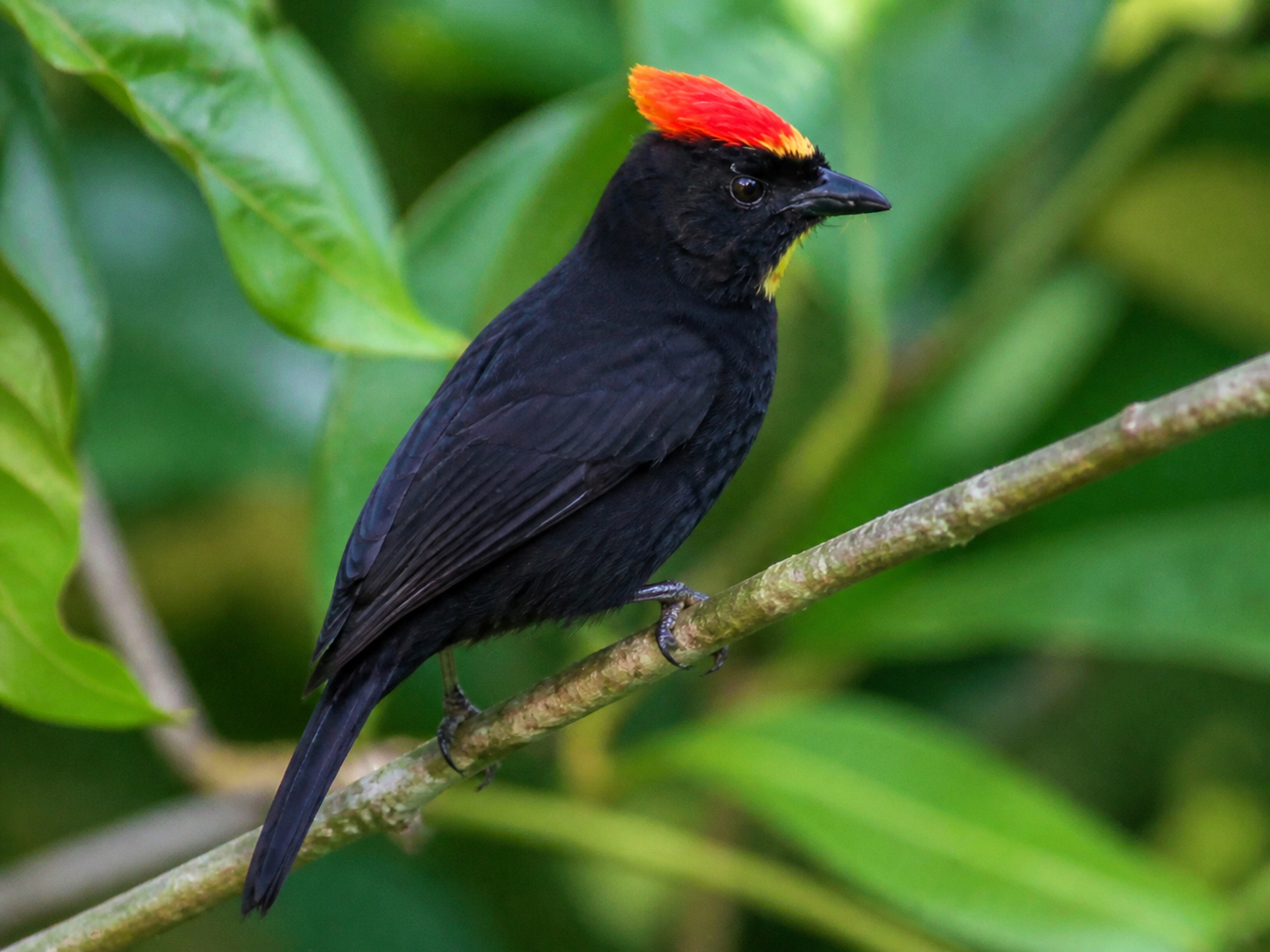
Quick Facts
- Scientific Name: Tachyphonus cristatus
- Spanish Name: Tangara crestiflama
- Family: Thraupidae
- Known Nicknames: Flame-crested Tanager
- Average Length: 14–15 cm / 5.5–5.9 in
- Average Weight: 18–26 g / 0.63–0.92 oz
- Wingspan: N/A
- Key Feature: Bright orange or yellow flame-like crest on the crown
- Primary Diet: Primarily Frugivore, also Insectivore
- Range: Amazon Basin and Guianas of South America (Brazil, Colombia, Venezuela, Guyana, Suriname, French Guiana, Ecuador, Peru, Bolivia)
- Habitat: Lowland humid tropical forest, forest edges, and secondary growth
- Social Structure: Highly Social; often found in mixed-species flocks
- Nesting/Breeding: Cup-shaped nest placed in tree fork or shrub
- Conservation Status: Least Concern (LC)
- Population Trend: Stable
The Flame-crested Tanager (*Tachyphonus cristatus*) is a striking songbird of South American lowland forests, most notable for the male’s brilliant, erectile orange-red crest that flares dramatically from the crown. Males are predominantly glossy black with a bold white wing patch and a fiery rump, while females are a more subdued olive-brown with a yellowish throat and breast, lacking the crest. This species is highly social, often foraging in mixed-species flocks for fruit and insects, and its unique, brush-like crest is used in visual displays to attract mates and assert dominance—a fiery flash that makes it one of the most charismatic tanagers in its range.
Fun Facts
The male Flame-crested Tanager has a bizarre courtship display where he fluffs his bright orange crest, droops his wings, and vibrates his body while singing a high-pitched, insect-like trill, often chasing the female through dense foliage in a frantic zigzag. Despite their vivid tropical colors, they sometimes engage in "anting," a quirky behavior where they rub ants on their feathers to use the formic acid as a natural insecticide and skin conditioner. Their stout, slightly hooked bill is uniquely adapted to crack open hard-shelled seeds and fruits, but they also perform acrobatic hangs upside-down to snatch berries from thin twigs. Another oddity: they are known to follow army ant swarms not for the ants, but to catch small insects and spiders fleeing the chaos.
Habitats & Distribution
The Flame-crested Tanager primarily inhabits humid lowland forests, including terra firme and várzea forests, as well as forest edges, clearings with scattered trees, and secondary growth. It is frequently found in the canopy and subcanopy, often associating with mixed-species flocks. Geographically, its range spans the Amazon Basin and the Guianas, occurring in southern Venezuela, the Guianas (Guyana, Suriname, French Guiana), eastern Ecuador, northeastern Peru, and much of northern and central Brazil (north of the Amazon River and into parts of Mato Grosso and Pará). It is generally resident throughout this distribution, though local movements may occur in response to fruit availability.
Behaviours & Reproduction
The Flame-crested Tanager is typically observed in small, loose family groups or as part of mixed-species foraging flocks, suggesting a partially cooperative social structure outside of breeding. Mating is presumed to be monogamous, with pairs forming during the breeding season. The male performs a courtship display involving wing-fluttering and raising his bright crest to attract a female. Nest construction is primarily the female’s task, building a cup-shaped nest in a tree fork using plant fibers and moss. The female lays a clutch of 2–3 eggs, which she incubates alone for about 13–14 days, while the male assists by bringing food. After hatching, both parents feed the nestlings, and fledging occurs around 15–18 days. A unique reproductive strategy is their reliance on active ant-following behavior; by foraging near army ant swarms, they exploit an abundant insect food source to provision chicks efficiently, reducing the time adults must spend away from the nest.
Diet
The Flame-crested Tanager is primarily frugivorous, with its diet consisting largely of a wide variety of ripe fruits, berries, and small figs, which it plucks directly from branches or occasionally catches in mid-air during brief sallies. Interestingly, this species is also an avid insectivore, supplementing its diet with insects, spiders, and other arthropods, particularly during the breeding season when protein demands for chicks increase. A lesser-known fact is that it frequently joins mixed-species foraging flocks, acting as a "beater" by flushing hidden insects from foliage as it moves, allowing other birds to snatch the prey. Additionally, it has been observed visiting bird feeders in some parts of its range to consume offered fruit, such as papaya and banana, and it occasionally drinks nectar from flowering trees, blurring the line between frugivory and nectarivory.
Colors
The male Flame-crested Tanager is primarily glossy black with a vivid, fiery orange-red crest and a similarly colored patch on the upper wing (the shoulder). The female is dull olive-brown above and yellowish below, lacking the crest, with a faintly streaked throat. Neither sex has camouflage adaptations; the male’s bold colors serve for display, while the female’s drab plumage provides concealment in forest understory.
Distribution Map
Places linked to this species. A sighting is never guaranteed.
Use the map filter to show only featured places.
Featured places
Tours where this species is featured

