Grass-green Tanager
Open Bird Bucket List ↗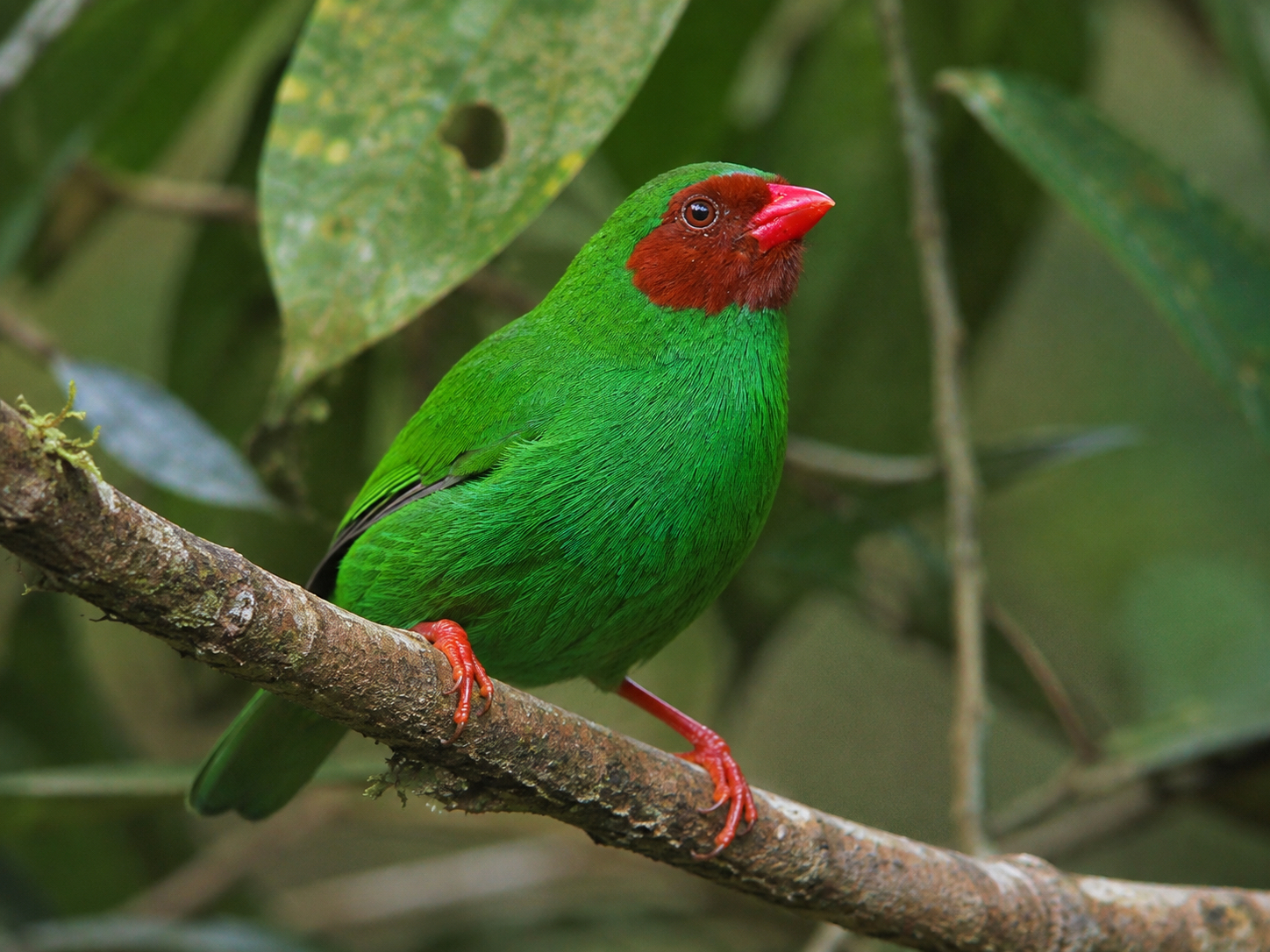
Quick Facts
- Scientific Name: Chlorornis riefferii
- Spanish Name: Tangara verdosa
- Family: Thraupidae
- Known Nicknames: Grass-green Tanager, Rieffer's Tanager
- Average Length: 20 cm / 8 in
- Average Weight: 45–60 g / 1.6–2.1 oz
- Wingspan: N/A
- Key Feature: Vivid grass-green plumage with a contrasting black mask and bib, and a bright orange-red bill and legs
- Primary Diet: Primarily Frugivore (fruit, berries, and some insects)
- Range: Andes of Colombia, Ecuador, Peru, and Bolivia
- Habitat: Montane cloud forest and humid highland forests, typically at elevations of 1,500–3,000 m
- Social Structure: Often found in pairs or small flocks, sometimes joining mixed-species feeding flocks
- Nesting/Breeding: Cup-shaped nest built in a tree fork or shrub, often hidden in moss
- Conservation Status: Least Concern (LC)
- Population Trend: Stable
The Grass-green Tanager (*Chlorornis riefferii*) is a dazzling jewel of the Andean cloud forests, instantly recognizable by its entirely vibrant, lime-green plumage that appears to glow amidst the misty foliage. Its most unique characteristic is a striking, contrasting set of features: a brilliant yellow-orange bill, a deep chestnut-red patch on the throat and upper chest, and, most distinctively, bright yellow feet and legs that look like it is wearing tiny, high-visibility boots. A special trait is its preference for high-altitude bamboo thickets, where it often moves in small, noisy flocks, using its stout bill to expertly pry open bamboo stems in search of insects. This bird’s electric coloration and unusual leg color make it one of the most memorable and sought-after sightings for birdwatchers in its limited range from Colombia to Bolivia.
Fun Facts
Despite its vibrant emerald plumage, the Grass-green Tanager is a master of camouflage in the Andean cloud forest, its green feathers blending perfectly with mossy branches rather than grass. It exhibits a quirky feeding behavior called “leaf-gleaning,” where it hangs upside down like a tiny acrobat to snatch insects and fruit from the undersides of leaves. A unique adaptation is its unusually thick, slightly hooked beak, which allows it to crack open hard seeds and tough berries that other tanagers cannot manage, giving it a competitive edge in its high-altitude habitat.
Habitats & Distribution
The Grass-green Tanager occupies humid montane forests and cloud forests, typically between 1,500 and 3,000 meters in elevation. It is most often found in the dense understory and edges of these high-altitude forests, sometimes venturing into adjacent shrubby clearings or second-growth woodland. Its geographical range is restricted to the eastern slopes of the Andes in South America, from central Peru south through Bolivia to extreme northwestern Argentina.
Behaviours & Reproduction
The Grass-green Tanager is a highly social species, typically found in small, stable flocks of 4 to 8 individuals that forage together in the Andean cloud forest canopy. Within these flocks, monogamous pair bonds are maintained, and both parents share responsibilities. Their mating ritual involves mutual preening and the male offering food to the female, a common courtship behavior among tanagers. Reproduction is cooperative; the female builds a cup-shaped mossy nest alone, but once she lays two pale blue eggs with brown speckles, the male and sometimes other flock members assist in feeding the chicks. A unique strategy is their reliance on these cooperative groups—likely composed of related individuals or previous offspring—to defend the nest and increase fledgling survival in their dense, predator-rich habitat.
Diet
The Grass-green Tanager's diet is predominantly frugivorous, consisting mainly of a wide variety of small, soft fruits and berries, which it plucks directly from branches while foraging in the understory and mid-levels of the cloud forest. A fascinating aspect of its feeding behavior is its strong attraction to bromeliads, where it not only consumes the fruits of these epiphytic plants but also regularly drinks the water collected in their leaf axils, an essential source of hydration in its montane habitat. Additionally, it supplements its fruit-based diet with insects and spiders, which it gleans from leaves and mossy branches, particularly during the breeding season to provide protein for its chicks.
Colors
The Grass-green Tanager is predominantly vivid grass-green, with a starkly contrasting black mask and throat. Its most unique feature is the rich, reddish-chestnut rump, lower belly, and undertail coverts, which break the green camouflage. It has a pale yellowish bill and lacks disruptive markings, relying instead on its green body to blend into the canopy.
Distribution Map
Places linked to this species. A sighting is never guaranteed.
Use the map filter to show only featured places.
Featured places
Tours where this species is featured


