Grassland Yellow-Finch
Open Bird Bucket List ↗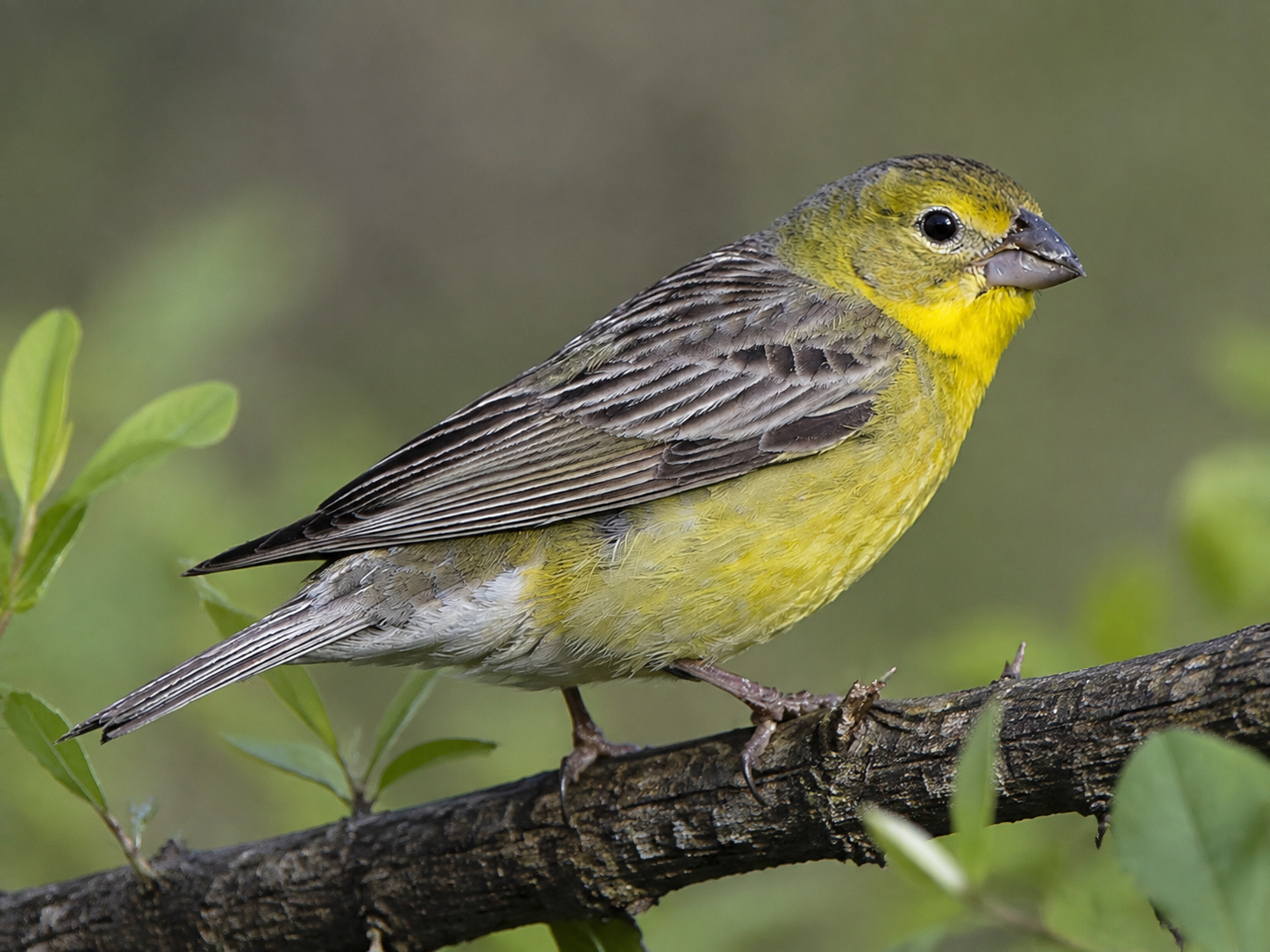
Quick Facts
- Scientific Name: Sicalis luteola
- Spanish Name: Semillero Sabanero
- Family: Thraupidae
- Known Nicknames: Yellow Grass-Finch, Savannah Yellow-Finch
- Average Length: 11–12 cm / 4.3–4.7 in
- Average Weight: 11–17 g / 0.39–0.60 oz
- Wingspan: 18–21 cm / 7.1–8.3 in
- Key Feature: Bright yellow underparts and rump contrasting with olive-brown upperparts
- Primary Diet: Primarily Granivore
- Range: Central Mexico through Central America and much of South America (east of the Andes) to central Argentina and Uruguay
- Habitat: Open grasslands, pastures, savannas, and agricultural fields
- Social Structure: Social; often found in small flocks, sometimes larger groups outside breeding season
- Nesting/Breeding: Cup-shaped nest in grass tussocks or low bushes, often on the ground
- Conservation Status: Least Concern (LC)
- Population Trend: Stable
The Grassland Yellow-Finch (*Sicalis luteola*) is a vibrant, small passerine bird that brings a splash of gold to the open grasslands, savannas, and agricultural fields of Central and South America. Its general appearance is defined by a bright, lemon-yellow body and face, contrasting with olive-streaked brown wings and a slightly forked tail; males are particularly vivid during the breeding season, while females and juveniles are duller with more brownish tones. A unique characteristic is its strong, conical bill, perfectly adapted for cracking seeds and grains, which form the bulk of its diet. Special features include a lively, undulating flight pattern and a cheerful, trilling song often delivered from a prominent perch, making it a conspicuous and engaging inhabitant of its namesake habitat.
Fun Facts
Despite its name, the Grassland Yellow-Finch is not a true finch but a tanager, a fact that often surprises birders. They have a quirky habit of dust-bathing in dry, sandy soil to remove parasites, sometimes doing so in groups that look like tiny, fluttering dust storms. Males perform a unique “butterfly flight” display during courtship, fluttering slowly with exaggerated wingbeats to show off their bright yellow plumage. An interesting adaptation is their ability to survive on very little water, extracting most of their moisture from seeds and insects in the arid grasslands they inhabit.
Habitats & Distribution
The Grassland Yellow-Finch occupies open, grassy habitats, primarily natural savannas, pastures, and agricultural fields, often near water sources like marshes or streams. It avoids dense forests and urban areas, favoring lowland regions with tall grasses and scattered shrubs for foraging and nesting. Geographically, its range extends discontinuously across South America, from Colombia and Venezuela through the Guianas and Brazil, southward to central Argentina and Uruguay, with isolated populations in parts of Peru, Bolivia, and Chile. It is also found on the islands of Trinidad and Tobago, and has been introduced to some Pacific islands like Hawaii.
Behaviours & Reproduction
The Grassland Yellow-Finch is a socially monogamous species, with pairs forming during the breeding season that corresponds to the local rainy period in its South American range. Males establish and defend small territories, often singing from elevated perches to attract a female and deter rivals. The pair builds a compact, cup-shaped nest woven from grasses and lined with softer materials, typically placed in a grass tussock or low shrub. The female alone incubates the clutch of two to four pale, speckled eggs for about 12–14 days, while the male provides food during this period. Both parents feed the nestlings, which fledge after roughly two weeks. A unique reproductive strategy is their tendency to breed in loose, semi-colonial aggregations where multiple pairs nest in close proximity, likely enhancing predator detection and defense against brood parasites like the Shiny Cowbird.
Diet
The Grassland Yellow-Finch is primarily granivorous, with seeds forming the bulk of its diet, particularly those from grasses and weeds found in its open grassland and savanna habitats. An interesting aspect of its feeding behavior is that it forages both on the ground and while clinging to seed heads, often in small flocks, and it will occasionally supplement its diet with small insects, especially during the breeding season to provide protein for its chicks. Remarkably, it has been observed feeding on fallen rice grains in agricultural fields, demonstrating its adaptability to human-modified landscapes.
Colors
The male Grassland Yellow-Finch is predominantly bright olive-yellow above and vivid yellow below, with a dusky, streaked back and wings that provide camouflage against dry grasses. Its face shows a distinct yellow supercilium and a dark, smudgy eye-line. The female is duller, with more extensive brownish streaking on the breast and back, aiding concealment while nesting. A unique feature is the fine, dark scaling on the crown and nape, blending with its grassland habitat.
Distribution Map
Places linked to this species. A sighting is never guaranteed.
Use the map filter to show only featured places.
Featured places
Tours where this species is featured


