Yellow-fronted Woodpecker
Open Bird Bucket List ↗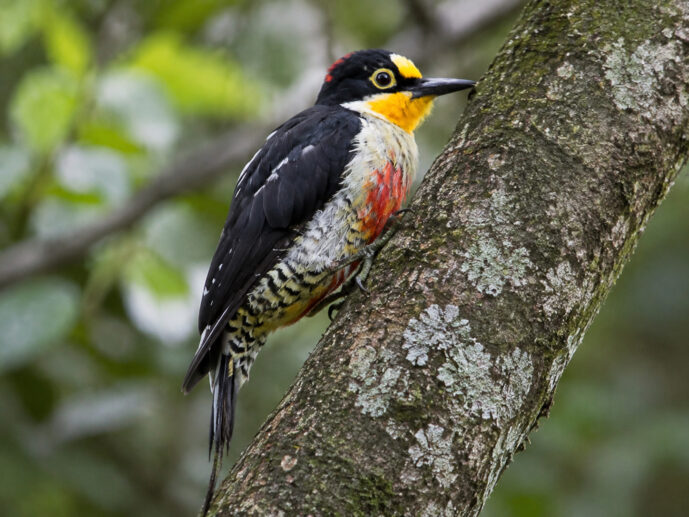
Quick Facts
- Scientific Name: Melanerpes flavifrons
- Spanish Name: Carpintero frentiamarillo
- Family: Picidae
- Known Nicknames: Yellow-fronted Woodpecker
- Average Length: 18–20 cm / 7–8 in
- Average Weight: 40–60 g / 1.4–2.1 oz
- Wingspan: 30–35 cm / 12–14 in
- Key Feature: Bright yellow forehead and crown, contrasting with black and white barred back
- Primary Diet: Primarily Insectivore (beetles, ants, termites), also fruits and berries
- Range: Eastern Brazil, Paraguay, northeastern Argentina
- Habitat: Atlantic Forest, Cerrado, and semi-deciduous woodlands; also plantations and urban parks
- Social Structure: Usually solitary or in pairs; occasionally in small family groups
- Nesting/Breeding: Tree cavities (excavated by both sexes)
- Conservation Status: Least Concern (LC)
- Population Trend: Stable
The Yellow-fronted Woodpecker (*Melanerpes flavifrons*) is a strikingly colorful bird endemic to Brazil’s Atlantic Forest, instantly recognizable by its bright golden-yellow forehead and nape that contrast sharply with its black-and-white barred back and wings. Its underparts are a warm, creamy buff, while males sport a vivid red crown patch absent in females. A unique characteristic is its social, semi-colonial nesting behavior—uncommon among woodpeckers—where multiple pairs may nest in close proximity, often reusing old cavities or even excavating in termite mounds. With a stout, chisel-like bill and a rapid, undulating flight, this lively species is both a charismatic forest resident and a key player in controlling insect populations.
Fun Facts
The Yellow-fronted Woodpecker has a bizarre habit of vigorously tapping on metal objects like gutters and lampposts, creating a deafeningly loud, rapid drumming that it uses to broadcast its territory far beyond what wood can achieve. It also stores live insects, particularly ants, by wedging them into tight bark crevices to eat later, a behavior called "larder hoarding" that is rare among woodpeckers. Uniquely, its tongue is not just long but equipped with backward-facing barbs and sticky saliva, allowing it to skewer and extract grubs from deep, winding tunnels with surgical precision.
Habitats & Distribution
This woodpecker is endemic to Brazil, with its distribution centered on the Atlantic Forest biome. Its geographical range extends from the state of Bahia southward to Rio Grande do Sul, and it also occurs in eastern Paraguay and the extreme northeastern tip of Argentina (Misiones). It inhabits humid and semi-deciduous lowland forests, forest edges, and secondary growth, but is also found in more open environments such as plantations, parks, and wooded gardens, typically from sea level up to around 1,000 meters in elevation.
Behaviours & Reproduction
The Yellow-fronted Woodpecker is generally monogamous, with pairs forming strong bonds that often persist across multiple breeding seasons. Mating involves mutual displays such as head-swinging and drumming duets, where both sexes tap on resonant trees to synchronize their pair bond and defend a small territory. They are cooperative breeders; offspring from previous broods frequently remain with their parents to help excavate new nest cavities and feed subsequent clutches. A unique reproductive strategy is their reliance on dead or decaying tree trunks, which they excavate anew each season, rarely reusing old nests. The female lays 3-4 white eggs, and both parents, along with any helpers, share incubation duties for about 14 days. The young fledge after roughly three weeks but may stay with the family group for several months, learning foraging techniques and reinforcing social cohesion. This cooperative system enhances survival rates in their fragmented Atlantic Forest habitat.
Diet
The Yellow-fronted Woodpecker (Melanerpes flavifrons) is primarily frugivorous, with fruits, berries, and seeds making up a large portion of its diet, but it is also an opportunistic insectivore that actively forages for beetles, ants, termites, and their larvae by gleaning bark and probing crevices. An interesting fact is that it often supplements its diet by visiting banana plantations and feeding on the sap of trees, sometimes drilling small holes in a ring pattern around a trunk to stimulate sap flow, a behavior more commonly associated with sapsuckers. Additionally, it has been observed raiding the nests of other birds to consume eggs and nestlings, and it will occasionally take nectar from flowers, making its feeding strategy highly adaptable to seasonal food availability.
Colors
The Yellow-fronted Woodpecker has a striking black-and-white barred back and wings, with a solid black tail. Its most distinctive feature is the bright yellow forehead and crown, contrasting with a red nape and white face and throat. Males also have a red central crown patch, while females lack this. The underparts are pale buffy-white with a black breast band and heavy black streaking on the flanks. Its black-and-white barring provides disruptive camouflage against tree bark, while the bold head colors serve as visual signals for communication rather than concealment.
Distribution Map
Places linked to this species. A sighting is never guaranteed.
Use the map filter to show only featured places.
Featured places
Tours where this species is featured


