Orange-billed Sparrow
Open Bird Bucket List ↗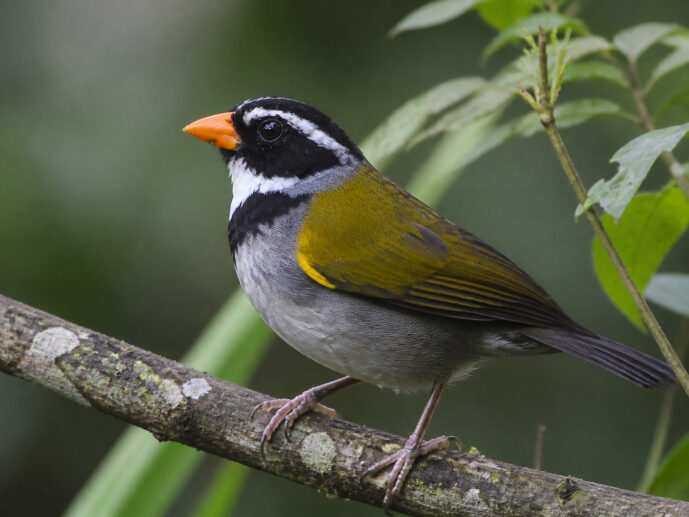
Quick Facts
- Scientific Name: Arremon aurantiirostris
- Spanish Name: Saltón piquinaranja
- Family: Passerellidae
- Known Nicknames: Orange-billed Brushfinch
- Average Length: 15–17 cm / 5.9–6.7 in
- Average Weight: 26–36 g / 0.92–1.27 oz
- Wingspan: N/A
- Key Feature: Bright orange bill contrasting with black and white facial pattern
- Primary Diet: Omnivore (seeds, insects, fruits)
- Range: Central America from southern Mexico to Panama, and northwestern South America (Colombia, Ecuador, Peru)
- Habitat: Understory of humid lowland and foothill forests, forest edges, and secondary growth
- Social Structure: Solitary or in pairs
- Nesting/Breeding: Domed nest built on or near the ground, often in dense vegetation
- Conservation Status: Least Concern (LC)
- Population Trend: Stable
The Orange-billed Sparrow (*Arremon aurantiirostris*) is a striking bird of Central and South American lowland forests, instantly recognizable by its vivid, carrot-orange bill that contrasts sharply with its bold, black-and-white head pattern. Its general appearance is sleek and sparrow-like, with a grayish-olive back, white underparts, and a distinctive white stripe above the eye that runs behind the head. A special feature of this species is its secretive, ground-foraging behavior, often hopping through leaf litter in pairs while emitting a sharp, metallic *tseep* call, and it is also notable for its strong territorial song, a series of clear, whistled notes that echo through the understory.
Fun Facts
Despite its brilliant orange bill, this bird is notoriously difficult to spot as it skulks through dense undergrowth, often foraging by flipping dead leaves with its bill like a miniature bulldozer. It possesses a remarkably loud, clear song for its size, which it delivers from a hidden perch, and pairs are known to engage in synchronized duets to defend their territory. A quirky behavior is its habit of “anting,” where it rubs ants on its feathers to use the formic acid as a natural insecticide against parasites.
Habitats & Distribution
The Orange-billed Sparrow inhabits the understory of humid lowland and foothill forests, typically below 1,200 meters elevation. It thrives in dense, tangled vegetation along forest edges, streamside thickets, and second-growth woodlands, often near damp ravines or areas with abundant leaf litter. Its geographical range extends from southern Mexico through Central America, including Belize, Guatemala, Honduras, Nicaragua, Costa Rica, and Panama, continuing into northwestern South America in Colombia and western Ecuador. This species is generally resident and non-migratory within its humid tropical forest habitats.
Behaviours & Reproduction
The Orange-billed Sparrow is generally monogamous and territorial, with pairs defending a small home range throughout the year. During the breeding season, which varies by region but often coincides with the rainy season, the male performs a simple courtship display involving song and chasing, and may present nesting material to the female. The female builds a bulky, domed nest with a side entrance, typically placed in a low bush or tangle of vines. She lays a clutch of two to three pale blue eggs with brown speckles, and incubation is carried out solely by the female for about 12–14 days. Both parents feed the nestlings, which fledge after roughly 12–15 days. A notable reproductive strategy is that young often remain with their parents for an extended period after fledging, sometimes assisting in feeding subsequent broods, a form of cooperative breeding that is relatively rare among New World sparrows. This delayed dispersal and helper system likely improves survival rates for the current brood and reduces predation risk for the parents.
Diet
The Orange-billed Sparrow is primarily a ground-foraging omnivore, with a diet dominated by seeds and small fallen fruits, such as those from melastomes and other understory shrubs. It also actively consumes a variety of small invertebrates, including beetles, ants, caterpillars, and spiders, which it gleans from leaf litter or low vegetation. An interesting fact is that it often forages in pairs or family groups, scratching vigorously at the forest floor like a tiny chicken to uncover hidden arthropods. During the dry season, when fruits are scarce, it shifts to a higher reliance on insects, demonstrating remarkable dietary flexibility within its humid lowland forest habitat.
Colors
The Orange-billed Sparrow features a striking white throat bordered by a bold black chest band and a black mask extending from the bill through the eyes. Its upperparts are olive-green, while the underparts are grayish-white, with bright orange legs and a vivid orange bill. Unique markings include a white supercilium and a black crown stripe, providing camouflage through disruptive coloration against dappled forest light.
Distribution Map
Places linked to this species. A sighting is never guaranteed.
Use the map filter to show only featured places.
Featured places
Tours where this species is featured


