Sunbittern
Open Bird Bucket List ↗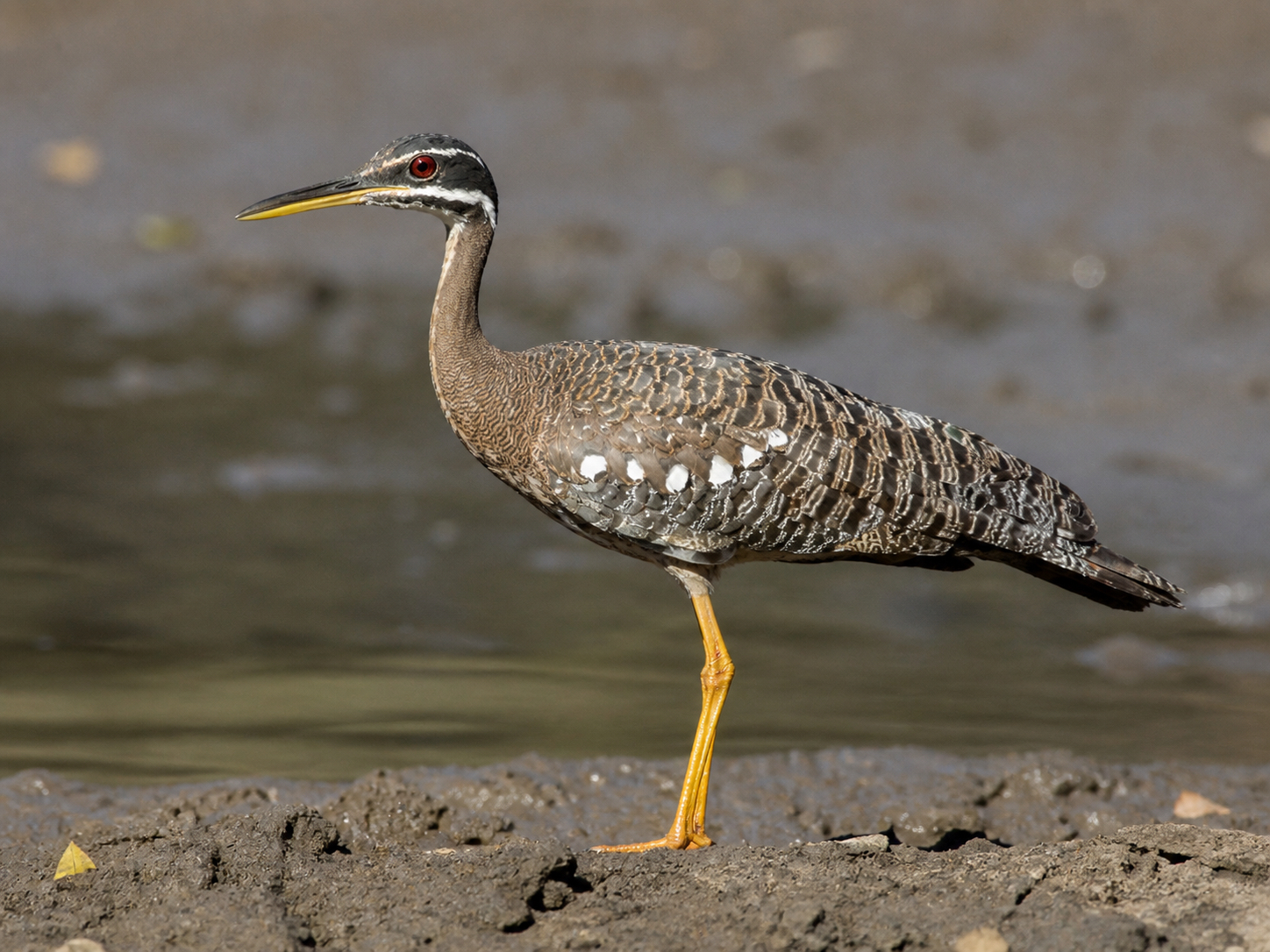
Quick Facts
- Scientific Name: Eurypyga helias
- Spanish Name: Garza del sol
- Family: Eurypygidae
- Known Nicknames: Sunbittern
- Average Length: 43–48 cm / 17–19 in
- Average Weight: 180–220 g / 6.3–7.8 oz
- Wingspan: N/A
- Key Feature: Large, eye-like ocelli on the wings, displayed during courtship or threat
- Primary Diet: Carnivore (insects, small fish, crustaceans, and amphibians)
- Range: Central and South America, from Guatemala to Brazil and Bolivia
- Habitat: Dense, humid lowland forests near streams and rivers
- Social Structure: Solitary or in pairs
- Nesting/Breeding: Platform nest of mud and vegetation placed in a tree fork or on a branch over water
- Conservation Status: Least Concern (LC)
- Population Trend: Decreasing
The Sunbittern (*Eurypyga helias*) is a strikingly elegant bird of Central and South American tropical forests, renowned for its dramatic, hidden beauty. Its general appearance is that of a slender, heron-like wader with a long neck, thin bill, and beautifully patterned plumage of brown, black, and buff, which provides perfect camouflage along shady stream banks. Its most unique characteristic is a spectacular display: when threatened or courting, it fans its broad wings and tail to reveal two enormous, eye-like "sunburst" patterns of vivid orange, red, and black, mimicking a large predator's face to startle attackers. A special feature is its ability to partially rotate its neck to align these false eyes on its wings, creating a hypnotic, symmetrical warning. This bird is a master of stealth, patiently hunting for fish and insects with a slow, deliberate gait, making its sudden, fiery display one of the most surprising and captivating sights in the avian world.
Fun Facts
The Sunbittern’s most spectacular trick is its “wing flash” display: when threatened or courting, it slowly spreads both wings to reveal enormous, eye-like orange-and-black ocelli (spots) on the upper surface, mimicking the stare of a large predator. Despite being a bird, it is also a surprisingly adept swimmer, often submerging its entire body to catch prey underwater. Its chicks are born with a unique, cryptic pattern that lets them freeze like stones, blending perfectly into riverbank pebbles. Another oddity: adults have an extra, comb-like claw on each wing (the alula) that they use to preen and remove parasites, a rare adaptation among birds.
Habitats & Distribution
The sunbittern is found in the lowland tropical forests of Central and South America, ranging from southern Mexico through Guatemala, Honduras, Nicaragua, Costa Rica, and Panama, then across much of the Amazon basin in Colombia, Ecuador, Peru, Bolivia, Venezuela, the Guianas, and Brazil. Its distribution also extends into Trinidad and Tobago. It exclusively inhabits dense, humid forests along slow-moving streams, rivers, and forested swamps, where it lives on or near the ground. The bird strongly prefers undisturbed primary forest with clear, shallow water and abundant overhanging vegetation, though it may occasionally venture into adjacent secondary growth or shaded creeks within plantations. It avoids open areas and deep, fast-flowing water.
Behaviours & Reproduction
The sunbittern is typically solitary or found in pairs, defending a permanent territory along forested streams. Its reproduction involves a unique and elaborate courtship display where the bird fans its wings and tail to reveal striking ocelli patterns, often while bowing and calling. The pair builds a shallow cup nest of mud and plant material in a tree fork or on a horizontal branch. Both parents share incubation duties for about 27–28 days and cooperatively feed the precocial chicks, which leave the nest soon after hatching but remain dependent on the parents for several weeks. A notable strategy is the use of the cryptic plumage and frozen posture to avoid detection on the nest, rather than aggressive defense.
Diet
The sunbittern is primarily a carnivorous bird that feeds on a diverse array of small aquatic and terrestrial prey. Its diet consists mainly of insects and their larvae, such as dragonfly nymphs and beetles, along with small fish, frogs, tadpoles, and crustaceans like shrimp and crabs. An interesting fact about its feeding behavior is that it often wades slowly through shallow streams and ponds, using its long, slender bill to probe mud and leaf litter or to snatch prey from the water’s surface with a quick, darting motion. Unlike many wading birds, the sunbittern is also known to occasionally hunt on land, capturing small lizards or snails in the dense undergrowth of its rainforest habitat. Another fascinating detail is that it will sometimes spread its wings while foraging, a behavior thought to startle hidden prey into movement or to cast a shadow that reduces glare on the water, improving its hunting accuracy.
Colors
The Sunbittern’s plumage is a muted blend of brown, gray, and buff, intricately patterned with fine black barring and vermiculations that provide excellent camouflage in dappled forest light. Its most striking feature is the large, hidden ocelli on each wing, which flash during display: a vivid patch of orange, chestnut, and black, ringed with white, resembling a pair of eyes. Additionally, its long tail is barred with black and white, while the neck and head display subtle streaks of white and rufous.
Distribution Map
Places linked to this species. A sighting is never guaranteed.
Use the map filter to show only featured places.
Featured places
Tours where this species is featured


